


The Direct Answer
A factory location can support daily goods movement only when the complete route—from highway to gate to loading area—works for the vehicles, volumes and timings of that business. Buyers should test last-mile roads, turning radius, congestion, loading space, monsoon access and distance to suppliers before comparing land prices.
Logistics Cost Is Created Every Day
A one-time difference in land price is visible during purchase. A poor route creates cost repeatedly through fuel, vehicle time, delayed dispatch, damaged material and driver waiting. This is why location must be evaluated as an operating expense, not only as an asset.
- Start with the Largest Regular Vehicle
A car-based site visit cannot test truck usability. Identify the largest vehicle that will enter weekly or daily and drive its full route. Note narrow turns, overhead restrictions, road shoulders and places where reversing is required.
- Observe Peak-Hour Conditions
A route that works at noon may slow during shift change, school traffic or market hours. Visit during the timings when raw material and dispatch will actually move.
- Test the Gate-to-Loading Journey
The internal journey matters as much as the public road. Measure gate width, turning radius, road width, waiting area and loading position. A truck should not block the road while loading.
- Calculate Supplier and Customer Time
Map the top suppliers, customers and transport hubs. Use realistic travel time instead of straight-line distance. Even ten minutes saved on a repeated route can become meaningful across hundreds of trips.
- Include Workforce Movement
Factory logistics also includes people. Check two-wheeler safety, staff transport routes, bus access and night-shift entry. A site that is difficult for workers can indirectly affect production and dispatch.
- Add the Monsoon Scenario
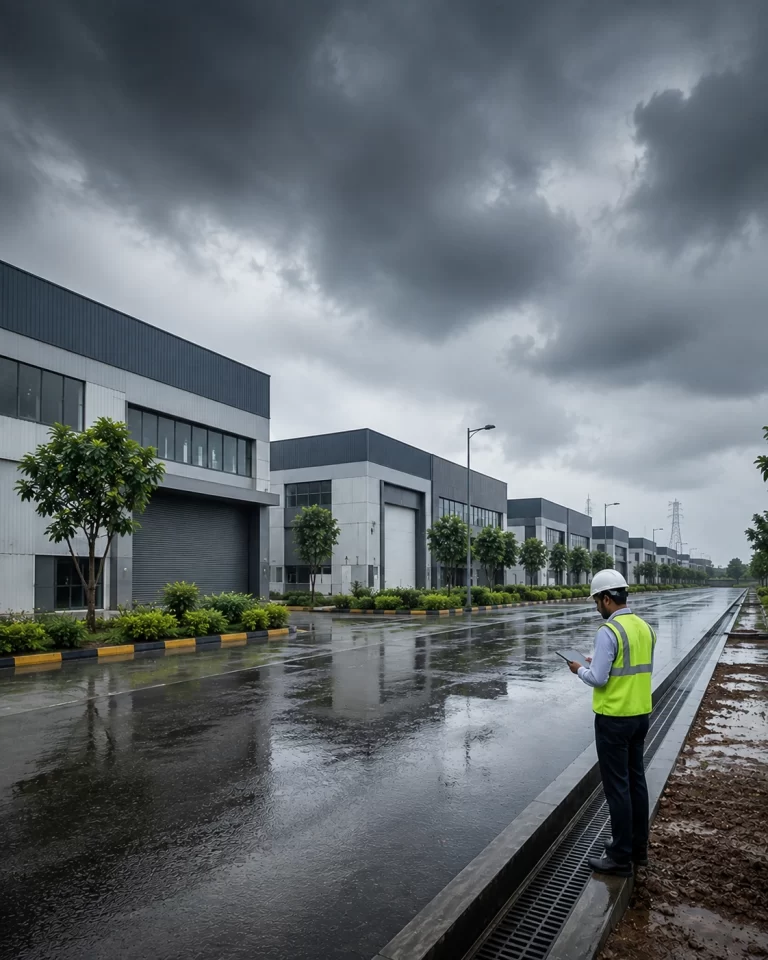
Repeat the route after rainfall. Water-covered edges, weak shoulders and damaged surfaces can change truck movement completely.
A Simple Logistics Scorecard
- Last-mile road quality and ownership.
- Truck passing and turning capacity.
- Loading and waiting space.
- Travel time to the nearest major road.
- Travel time to top suppliers and customers.
- Worker access across shifts.
- Monsoon reliability.
- Security and entry management.
The GM Group Project Lens
GM Group selects industrial locations near Sachin GIDC, Hoziwala, Palsana and major road corridors to support manufacturing, warehousing and distribution. Diamond Industrial Park – 2 is positioned for urban proximity and industrial scalability, while Diamond Industrial Park Carat 4 at Makhinga–Palsana is presented as a future-ready industrial ecosystem.
For buyers, the value of these projects should be tested in movement terms: fewer bottlenecks, planned internal access, dependable infrastructure and connection to an operating industrial network.
Final Takeaway
Do not ask only, “How far is the highway?” Ask, “How long does my truck take from the highway to my loading bay at the busiest and wettest time of day?” That answer is closer to the real logistics value of the property.
Frequently Asked Questions
What is last-mile industrial connectivity?
It is the final route connecting a factory or warehouse to a major road, highway, supplier network or transport hub.
Why is turning radius important?
Insufficient turning space can cause delays, unsafe reversing and damage to roads, vehicles or property.
How should a warehouse evaluate a location?
It should prioritise truck access, loading flow, dispatch connectivity, security, storage conditions and uninterrupted all-season movement.
Which GM Group projects are relevant to logistics-led businesses?
Diamond Industrial Park – 2 near Sachin and Diamond Industrial Park Carat 4 at Makhinga–Palsana are positioned for factory, warehouse and industrial growth requirements.
Should transporters be involved in site selection?
Yes. Drivers and transporters often identify route problems that a passenger-vehicle visit will miss.