


The Direct Answer
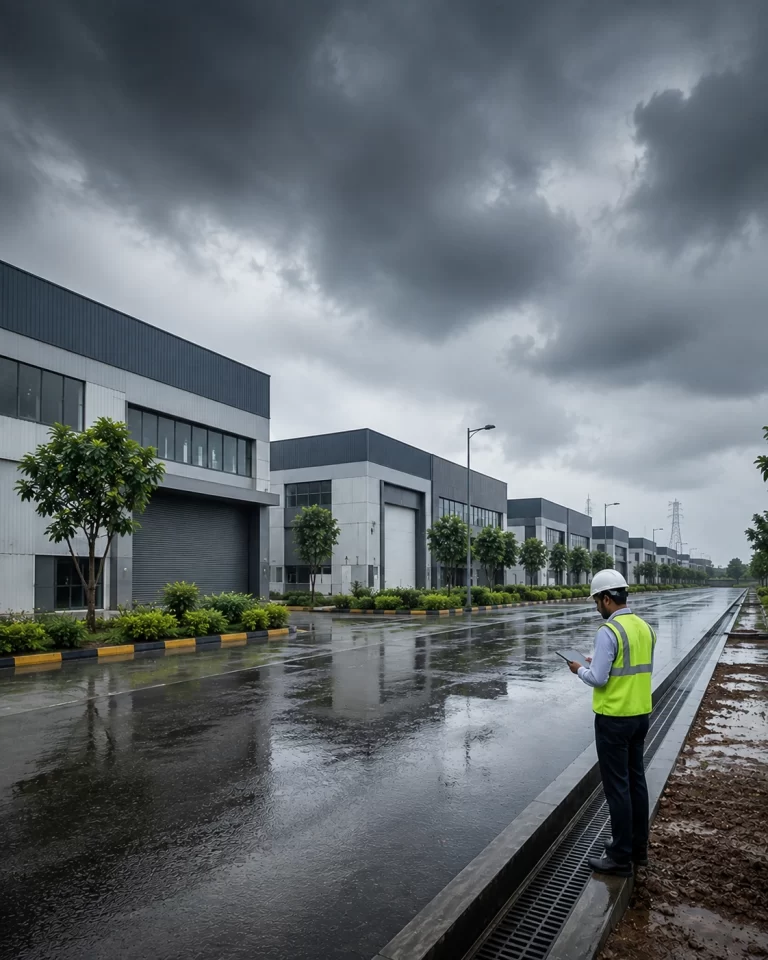
The monsoon is one of the most useful times to inspect industrial property in Surat because it reveals drainage performance, road durability, plot levels and last-mile accessibility under real conditions. A buyer should not judge a property only by whether water is visible during rain; the important test is where the water goes, how quickly it clears and whether factory movement continues safely.
Why August Is a Better Test Than a Brochure Visit
A dry site can make every road look functional and every plot look level. Rain exposes low points, blocked outlets, weak shoulders, unfinished surfaces and water entering from neighbouring land. For a business that must operate throughout the year, these are not cosmetic concerns. They can affect worker attendance, truck movement, construction cost and production continuity.
- Check Plot Level Against the Road
Stand at the road edge and compare the plot level with the surrounding surface. A low plot may require additional filling, compaction and a higher finished-floor level. Ask for a level survey instead of depending only on eyesight.
- Follow the Water, Not Just the Drain
A visible drain is useful only when it has the correct slope, capacity and discharge point. Trace where stormwater is intended to leave the industrial park. Ask how outlets are cleaned and whether neighbouring runoff enters the site.
- Inspect the Last Mile Used by Trucks
Drive the exact route that raw-material and dispatch vehicles will use. Look for narrow turns, water-covered road edges, potholes, soft shoulders, settlement traffic and sections where two heavy vehicles cannot pass.
- Test Internal Roads for Industrial Loads
Industrial roads must support repeated commercial-vehicle movement. Inspect settlement near drains, broken edges, standing water at junctions and turning areas where trucks are forced outside the paved surface.
- Evaluate Gate, Ramp and Loading Levels Together
A steep ramp may prevent water entry but create loading difficulty. A flat entrance may be convenient but vulnerable to runoff. Gate width, turning radius, finished-floor level and loading-bay position should be tested as one system.
- Ask How Electrical Infrastructure Is Protected
Confirm the location of panels, distribution points, transformers and underground cable routes. Ask how they are marked, maintained and protected from water accumulation.
- Check Common-Area Maintenance Responsibility
Good infrastructure can fail without maintenance. Buyers should know who cleans drains, repairs roads, manages streetlights and controls common areas after possession. GM Group’s proposition includes dedicated management support so businesses can focus on operations while the park environment is maintained.
- Visit Twice: During Rain and After Rain
The first visit shows water flow. The second, two to four hours later, shows whether the system clears. Record the same points with photographs and compare them before making a decision.
Ground Report Checklist
- Photograph the plot corners, road junctions, drains and proposed gate location.
- Ask neighbouring factory owners about the previous two monsoons.
- Check whether workers and two-wheelers can enter safely during rain.
- Observe truck movement at peak operating time.
- Obtain a level survey and preliminary drainage plan before construction costing.
- Review who owns and maintains the approach road.
The GM Group Project Lens
Diamond Industrial Park – 2 is positioned by GM Group as a plug-and-play industrial environment with wide road connectivity, advanced drainage, high-tension power and ready infrastructure. These features should not remain brochure terms; buyers should inspect how they function on site.
The strongest brand message for GM Group here is consistent with its own philosophy: infrastructure should solve problems, not create them. A monsoon inspection is one of the clearest ways to test that promise.
Final Takeaway
A monsoon site visit does not replace title verification, approvals, engineering surveys or legal due diligence. It adds the operational evidence that paperwork cannot provide. The best industrial site is not the one that looks perfect for thirty minutes—it is the one that keeps working through an entire season.
Frequently Asked Questions
Is monsoon a good time to buy industrial property?
It is a good time to inspect property because drainage and road performance are visible. The purchase decision should still include legal, technical and financial due diligence.
How long should water take to clear?
There is no universal time because rainfall intensity and drainage design differ. Buyers should ask an engineer to evaluate whether the observed clearing time is appropriate for the site.
What is the most important monsoon check?
The complete water path—from plot and road surface to drain and final outlet—is more important than any single visible feature.
Should buyers speak to neighbouring factories?
Yes. Existing users can provide practical information about access, waterlogging, power interruptions and maintenance response.
What GM Group feature is relevant to monsoon operations?
Diamond Industrial Park – 2 highlights planned drainage, road connectivity, utilities and management support as part of its organised industrial environment.